Changelog
For detailed changes from the prior release, click on the version number, and
its link will bring up a GitHub listing of changes. Use git log on the
command line for details.
1.0
1.0.0 2019-05-03
JupyterHub 1.0 is a major milestone for JupyterHub. Huge thanks to the many people who have contributed to this release, whether it was through discussion, testing, documentation, or development.
Major new features
Support TLS encryption and authentication of all internal communication. Spawners must implement
.move_certsmethod to make certificates available to the notebook server if it is not local to the Hub.There is now full UI support for managing named servers. With named servers, each jupyterhub user may have access to more than one named server. For example, a professor may access a server named
researchand another namedteaching.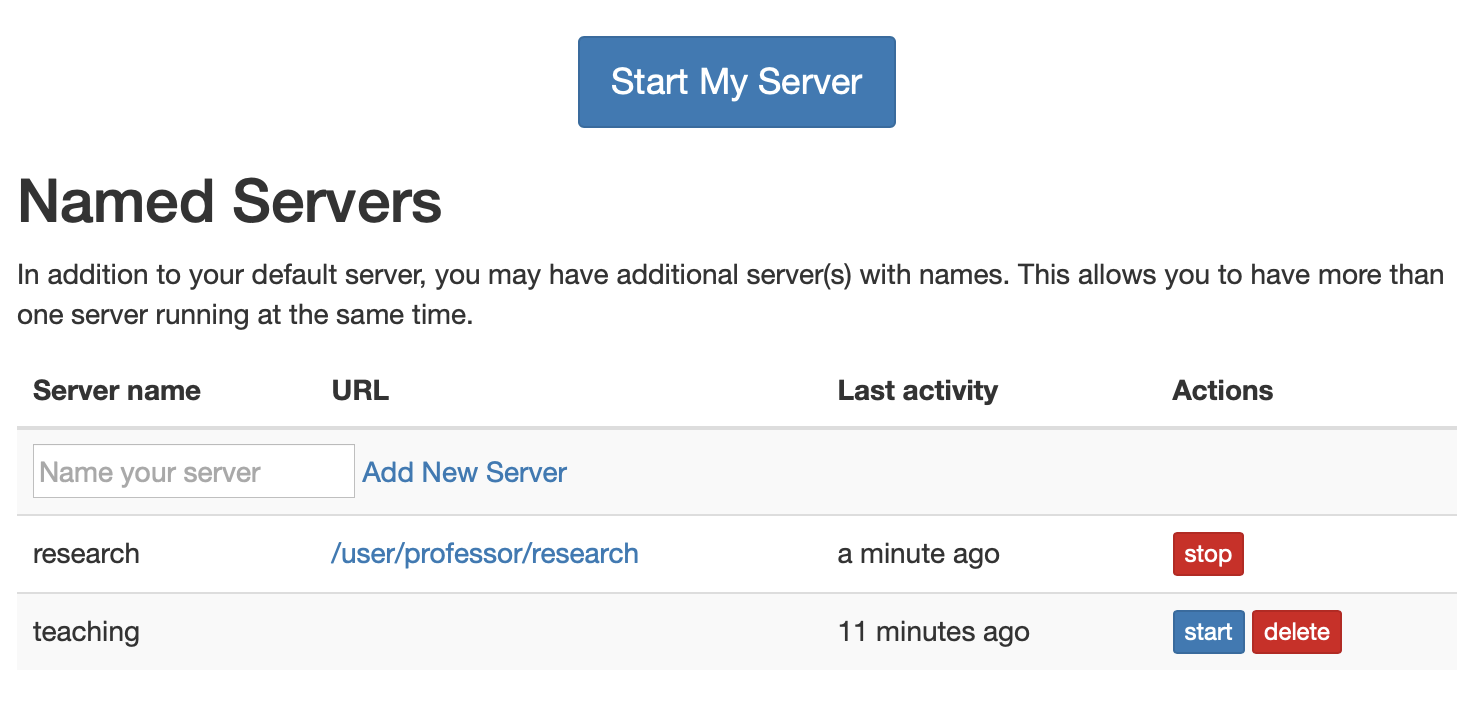
Authenticators can now expire and refresh authentication data by implementing
Authenticator.refresh_user(user). This allows things like OAuth data and access tokens to be refreshed. When used together withAuthenticator.refresh_pre_spawn = True, auth refresh can be forced prior to Spawn, allowing the Authenticator to require that authentication data is fresh immediately before the user’s server is launched.
New features
allow custom spawners, authenticators, and proxies to register themselves via ‘entry points’, enabling more convenient configuration such as:
c.JupyterHub.authenticator_class = 'github'
c.JupyterHub.spawner_class = 'docker'
c.JupyterHub.proxy_class = 'traefik_etcd'
Spawners are passed the tornado Handler object that requested their spawn (as
self.handler), so they can do things like make decisions based on query arguments in the request.SimpleSpawner and DummyAuthenticator, which are useful for testing, have been merged into JupyterHub itself:
# For testing purposes only. Should not be used in production.
c.JupyterHub.authenticator_class = 'dummy'
c.JupyterHub.spawner_class = 'simple'
These classes are not appropriate for production use. Only testing.
Add health check endpoint at
/hub/healthSeveral prometheus metrics have been added (thanks to Outreachy applicants!)
A new API for registering user activity. To prepare for the addition of alternate proxy implementations, responsibility for tracking activity is taken away from the proxy and moved to the notebook server (which already has activity tracking features). Activity is now tracked by pushing it to the Hub from user servers instead of polling the proxy API.
Dynamic
options_formcallables may now return an empty string which will result in no options form being rendered.Spawner.user_optionsis persisted to the database to be re-used, so that a server spawned once via the form can be re-spawned via the API with the same options.Added
c.PAMAuthenticator.pam_normalize_usernameoption for round-tripping usernames through PAM to retrieve the normalized form.Added
c.JupyterHub.named_server_limit_per_userconfiguration to limit the number of named servers each user can have. The default is 0, for no limit.API requests to HubAuthenticated services (e.g. single-user servers) may pass a token in the
Authorizationheader, matching authentication with the Hub API itself.Added
Authenticator.is_admin(handler, authentication)method andAuthenticator.admin_groupsconfiguration for automatically determining that a member of a group should be considered an admin.New
c.Authenticator.post_auth_hookconfiguration that can be any callable of the formasync def hook(authenticator, handler, authentication=None):. This hook may transform the return value ofAuthenticator.authenticate()and return a new authentication dictionary, e.g. specifying admin privileges, group membership, or custom white/blacklisting logic. This hook is called after existing normalization and whitelist checking.Spawner.options_from_formmay now be asyncAdded
JupyterHub.shutdown_on_logoutoption to trigger shutdown of a user’s servers when they log out.When
Spawner.startraises an Exception, a message can be passed on to the user if the exception has a.jupyterhub_messageattribute.
Changes
Authentication methods such as
check_whitelistshould now take an additionalauthenticationargument that will be a dictionary (default: None) of authentication data, as returned byAuthenticator.authenticate():def check_whitelist(self, username, authentication=None): ...
authenticationshould have a default value of None for backward-compatibility with jupyterhub < 1.0.Prometheus metrics page is now authenticated. Any authenticated user may see the prometheus metrics. To disable prometheus authentication, set
JupyterHub.authenticate_prometheus = False.Visits to
/user/:nameno longer trigger an implicit launch of the user’s server. Instead, a page is shown indicating that the server is not running with a link to request the spawn.API requests to
/user/:namefor a not-running server will have status 503 instead of 404.OAuth includes a confirmation page when attempting to visit another user’s server, so that users can choose to cancel authentication with the single-user server. Confirmation is still skipped when accessing your own server.
Fixed
Various fixes to improve Windows compatibility (default Authenticator and Spawner still do not support Windows, but other Spawners may)
Fixed compatibility with Oracle db
Fewer redirects following a visit to the default
/urlError when progress is requested before progress is ready
Error when API requests are made to a not-running server without authentication
Avoid logging database password on connect if password is specified in
JupyterHub.db_url.
Development changes
There have been several changes to the development process that shouldn’t
generally affect users of JupyterHub, but may affect contributors.
In general, see CONTRIBUTING.md for contribution info or ask if you have questions.
JupyterHub has adopted
blackas a code autoformatter andpre-commitas a tool for automatically running code formatting on commit. This is meant to make it easier to contribute to JupyterHub, so let us know if it’s having the opposite effect.JupyterHub has switched its test suite to using
pytest-asynciofrompytest-tornado.OAuth is now implemented internally using
oauthlibinstead ofpython-oauth2. This should have no effect on behavior.
0.9
0.9.6 2019-04-01
JupyterHub 0.9.6 is a security release.
Fixes an Open Redirect vulnerability (CVE-2019-10255).
JupyterHub 0.9.5 included a partial fix for this issue.
0.9.4 2018-09-24
JupyterHub 0.9.4 is a small bugfix release.
Fixes an issue that required all running user servers to be restarted when performing an upgrade from 0.8 to 0.9.
Fixes content-type for API endpoints back to
application/json. It wastext/htmlin 0.9.0-0.9.3.
0.9.3 2018-09-12
JupyterHub 0.9.3 contains small bugfixes and improvements
Fix token page and model handling of
expires_at. This field was missing from the REST API model for tokens and could cause the token page to not renderAdd keep-alive to progress event stream to avoid proxies dropping the connection due to inactivity
Documentation and example improvements
Disable quit button when using notebook 5.6
Prototype new feature (may change prior to 1.0): pass requesting Handler to Spawners during start, accessible as
self.handler
0.9.2 2018-08-10
JupyterHub 0.9.2 contains small bugfixes and improvements.
Documentation and example improvements
Add
Spawner.consecutive_failure_limitconfig for aborting the Hub if too many spawns fail in a row.Fix for handling SIGTERM when run with asyncio (tornado 5)
Windows compatibility fixes
0.9.1 2018-07-04
JupyterHub 0.9.1 contains a number of small bugfixes on top of 0.9.
Use a PID file for the proxy to decrease the likelihood that a leftover proxy process will prevent JupyterHub from restarting
c.LocalProcessSpawner.shell_cmdis now configurableAPI requests to stopped servers (requests to the hub for
/user/:name/api/...) fail with 404 rather than triggering a restart of the serverCompatibility fix for notebook 5.6.0 which will introduce further security checks for local connections
Managed services always use localhost to talk to the Hub if the Hub listening on all interfaces
When using a URL prefix, the Hub route will be
JupyterHub.base_urlinstead of unconditionally/additional fixes and improvements
0.9.0 2018-06-15
JupyterHub 0.9 is a major upgrade of JupyterHub. There are several changes to the database schema, so make sure to backup your database and run:
jupyterhub upgrade-db
after upgrading jupyterhub.
The biggest change for 0.9 is the switch to asyncio coroutines everywhere instead of tornado coroutines. Custom Spawners and Authenticators are still free to use tornado coroutines for async methods, as they will continue to work. As part of this upgrade, JupyterHub 0.9 drops support for Python < 3.5 and tornado < 5.0.
Changed
Require Python >= 3.5
Require tornado >= 5.0
Use asyncio coroutines throughout
Set status 409 for conflicting actions instead of 400, e.g. creating users or groups that already exist.
timestamps in REST API continue to be UTC, but now include ‘Z’ suffix to identify them as such.
REST API User model always includes
serversdict, not just when named servers are enabled.serverinfo is no longer available to oauth identification endpoints, only user info and group membership.User.last_activitymay be None if a user has not been seen, rather than starting with the user creation time which is now separately stored asUser.created.static resources are now found in
$PREFIX/share/jupyterhubinstead ofshare/jupyter/hubfor improved consistency.Deprecate
.extra_log_fileconfig. Use pipe redirection instead:jupyterhub &>> /var/log/jupyterhub.log
Add
JupyterHub.bind_urlconfig for setting the full bind URL of the proxy. Sets ip, port, base_url all at once.Add
JupyterHub.hub_bind_urlfor setting the full host+port of the Hub.hub_bind_urlsupports unix domain sockets, e.g.unix+http://%2Fsrv%2Fjupyterhub.sockDeprecate
JupyterHub.hub_connect_portconfig in favor ofJupyterHub.hub_connect_url.hub_connect_ipis not deprecated and can still be used in the common case where only the ip address of the hub differs from the bind ip.
Added
Spawners can define a
.progressmethod which should be an async generator. The generator should yield events of the form:{ "message": "some-state-message", "progress": 50, }
These messages will be shown with a progress bar on the spawn-pending page. The
async_generatorpackage can be used to make async generators compatible with Python 3.5.track activity of individual API tokens
new REST API for managing API tokens at
/hub/api/user/tokens[/token-id]allow viewing/revoking tokens via token page
User creation time is available in the REST API as
User.createdServer start time is stored as
Server.startedSpawner.startmay return a URL for connecting to a notebook instead of(ip, port). This enables Spawners to launch servers that setup their own HTTPS.Optimize database performance by disabling sqlalchemy expire_on_commit by default.
Add
python -m jupyterhub.dbutil shellentrypoint for quickly launching an IPython session connected to your JupyterHub database.Include
User.auth_statein user model on single-user REST endpoints for admins only.Include
Server.statein server model on REST endpoints for admins only.Add
Authenticator.blacklistfor blacklisting users instead of whitelisting.Pass
c.JupyterHub.tornado_settings['cookie_options']down to Spawners so that cookie options (e.g.expires_days) can be set globally for the whole application.SIGINFO (
ctrl-t) handler showing the current status of all running threads, coroutines, and CPU/memory/FD consumption.Add async
Spawner.get_options_formalternative to.options_form, so it can be a coroutine.Add
JupyterHub.redirect_to_serverconfig to govern whether users should be sent to their server on login or the JupyterHub home page.html page templates can be more easily customized and extended.
Allow registering external OAuth clients for using the Hub as an OAuth provider.
Add basic prometheus metrics at
/hub/metricsendpoint.Add session-id cookie, enabling immediate revocation of login tokens.
Authenticators may specify that users are admins by specifying the
adminkey when return the user model as a dict.Added “Start All” button to admin page for launching all user servers at once.
Services have an
infofield which is a dictionary. This is accessible via the REST API.JupyterHub.extra_handlersallows defining additional tornado RequestHandlers attached to the Hub.API tokens may now expire. Expiry is available in the REST model as
expires_at, and settable when creating API tokens by specifyingexpires_in.
Fixed
Remove green from theme to improve accessibility
Fix error when proxy deletion fails due to route already being deleted
clear
?redirectsfrom URL on successful launchdisable send2trash by default, which is rarely desirable for jupyterhub
Put PAM calls in a thread so they don’t block the main application in cases where PAM is slow (e.g. LDAP).
Remove implicit spawn from login handler, instead relying on subsequent request for
/user/:nameto trigger spawn.Fixed several inconsistencies for initial redirects, depending on whether server is running or not and whether the user is logged in or not.
Admin requests for
/user/:name(when admin-access is enabled) launch the right server if it’s not running instead of redirecting to their own.Major performance improvement starting up JupyterHub with many users, especially when most are inactive.
Various fixes in race conditions and performance improvements with the default proxy.
Fixes for CORS headers
Stop setting
.form-controlon spawner form inputs unconditionally.Better recovery from database errors and database connection issues without having to restart the Hub.
Fix handling of
~character in usernames.Fix jupyterhub startup when
getpass.getuser()would fail, e.g. due to missing entry in passwd file in containers.
0.8
0.8.1 2017-11-07
JupyterHub 0.8.1 is a collection of bugfixes and small improvements on 0.8.
Added
Run tornado with AsyncIO by default
Add
jupyterhub --upgrade-dbflag for automatically upgrading the database as part of startup. This is useful for cases where manually runningjupyterhub upgrade-dbas a separate step is unwieldy.Avoid creating backups of the database when no changes are to be made by
jupyterhub upgrade-db.
Fixed
Add some further validation to usernames -
/is not allowed in usernames.Fix empty logout page when using auto_login
Fix autofill of username field in default login form.
Fix listing of users on the admin page who have not yet started their server.
Fix ever-growing traceback when re-raising Exceptions from spawn failures.
Remove use of deprecated
bowerfor javascript client dependencies.
0.8.0 2017-10-03
JupyterHub 0.8 is a big release!
Perhaps the biggest change is the use of OAuth to negotiate authentication between the Hub and single-user services. Due to this change, it is important that the single-user server and Hub are both running the same version of JupyterHub. If you are using containers (e.g. via DockerSpawner or KubeSpawner), this means upgrading jupyterhub in your user images at the same time as the Hub. In most cases, a
pip install jupyterhub==version
in your Dockerfile is sufficient.
Added
JupyterHub now defined a
ProxyAPI for custom proxy implementations other than the default. The defaults are unchanged, but configuration of the proxy is now done on theConfigurableHTTPProxyclass instead of the top-level JupyterHub. TODO: docs for writing a custom proxy.Single-user servers and services (anything that uses HubAuth) can now accept token-authenticated requests via the Authentication header.
Authenticators can now store state in the Hub’s database. To do so, the
authenticatemethod should return a dict of the form{ 'username': 'name', 'state': {} }
This data will be encrypted and requires
JUPYTERHUB_CRYPT_KEYenvironment variable to be set and theAuthenticator.enable_auth_stateflag to be True. If these are not set, auth_state returned by the Authenticator will not be stored.There is preliminary support for multiple (named) servers per user in the REST API. Named servers can be created via API requests, but there is currently no UI for managing them.
Add
LocalProcessSpawner.popen_kwargsandLocalProcessSpawner.shell_cmdfor customizing how user server processes are launched.Add
Authenticator.auto_loginflag for skipping the “Login with…” page explicitly.Add
JupyterHub.hub_connect_ipconfiguration for the ip that should be used when connecting to the Hub. This is promoting (and deprecating)DockerSpawner.hub_ip_connectfor use by all Spawners.Add
Spawner.pre_spawn_hook(spawner)hook for customizing pre-spawn events.Add
JupyterHub.active_server_limitandJupyterHub.concurrent_spawn_limitfor limiting the total number of running user servers and the number of pending spawns, respectively.
Changed
more arguments to spawners are now passed via environment variables (
.get_env()) rather than CLI arguments (.get_args())internally generated tokens no longer get extra hash rounds, significantly speeding up authentication. The hash rounds were deemed unnecessary because the tokens were already generated with high entropy.
JUPYTERHUB_API_TOKENenv is available at all times, rather than being removed during single-user start. The token is now accessible to kernel processes, enabling user kernels to make authenticated API requests to Hub-authenticated services.Cookie secrets should be 32B hex instead of large base64 secrets.
pycurl is used by default, if available.
Fixed
So many things fixed!
Collisions are checked when users are renamed
Fix bug where OAuth authenticators could not logout users due to being redirected right back through the login process.
If there are errors loading your config files, JupyterHub will refuse to start with an informative error. Previously, the bad config would be ignored and JupyterHub would launch with default configuration.
Raise 403 error on unauthorized user rather than redirect to login, which could cause redirect loop.
Set
httponlyon cookies because it’s prudent.Improve support for MySQL as the database backend
Many race conditions and performance problems under heavy load have been fixed.
Fix alembic tagging of database schema versions.
Removed
End support for Python 3.3
0.7
0.7.2 - 2017-01-09
Added
Support service environment variables and defaults in
jupyterhub-singleuserfor easier deployment of notebook servers as a Service.Add
--groupparameter for deployingjupyterhub-singleuseras a Service with group authentication.Include URL parameters when redirecting through
/user-redirect/
Fixed
Fix group authentication for HubAuthenticated services
0.7.1 - 2017-01-02
Added
Spawner.will_resumefor signaling that a single-user server is paused instead of stopped. This is needed for cases likeDockerSpawner.remove_containers = False, where the first API token is re-used for subsequent spawns.Warning on startup about single-character usernames, caused by common
set('string')typo in config.
Fixed
Removed spurious warning about empty
next_url, which is AOK.
0.7.0 - 2016-12-2
Added
Implement Services API #705
Add
/api/and/api/infoendpoints #675Add documentation for JupyterLab, pySpark configuration, troubleshooting, and more.
Add logging of error if adding users already in database. #689
Add HubAuth class for authenticating with JupyterHub. This class can be used by any application, even outside tornado.
Add user groups.
Add
/hub/user-redirect/...URL for redirecting users to a file on their own server.
Changed
0.6
0.6.1 - 2016-05-04
Bugfixes on 0.6:
statsd is an optional dependency, only needed if in use
Notice more quickly when servers have crashed
Better error pages for proxy errors
Add Stop All button to admin panel for stopping all servers at once
0.6.0 - 2016-04-25
JupyterHub has moved to a new
jupyterhubnamespace on GitHub and Docker. What wasjuptyer/jupyterhubis nowjupyterhub/jupyterhub, etc.jupyterhub/jupyterhubimage on DockerHub no longer loads the jupyterhub_config.py in an ONBUILD step. A newjupyterhub/jupyterhub-onbuildimage does thisAdd statsd support, via
c.JupyterHub.statsd_{host,port,prefix}Update to traitlets 4.1
@default,@observeAPIs for traitsAllow disabling PAM sessions via
c.PAMAuthenticator.open_sessions = False. This may be needed on SELinux-enabled systems, where our PAM session logic often does not work properlyAdd
Spawner.environmentconfigurable, for defining extra environment variables to load for single-user serversJupyterHub API tokens can be pregenerated and loaded via
JupyterHub.api_tokens, a dict oftoken: username.JupyterHub API tokens can be requested via the REST API, with a POST request to
/api/authorizations/token. This can only be used if the Authenticator has a username and password.Various fixes for user URLs and redirects
0.5 - 2016-03-07
Single-user server must be run with Jupyter Notebook ≥ 4.0
Require
--no-sslconfirmation to allow the Hub to be run without SSL (e.g. behind SSL termination in nginx)Add lengths to text fields for MySQL support
Add
Spawner.disable_user_configfor preventing user-owned configuration from modifying single-user servers.Fixes for MySQL support.
Add ability to run each user’s server on its own subdomain. Requires wildcard DNS and wildcard SSL to be feasible. Enable subdomains by setting
JupyterHub.subdomain_host = 'https://jupyterhub.domain.tld[:port]'.Use
127.0.0.1for local communication instead oflocalhost, avoiding issues with DNS on some systems.Fix race that could add users to proxy prematurely if spawning is slow.
0.4
0.4.0 - 2016-02-01
Add
Spawner.user_options_formfor specifying an HTML form to present to users, allowing users to influence the spawning of their own servers.Add
Authenticator.pre_spawn_startandAuthenticator.post_spawn_stophooks, so that Authenticators can do setup or teardown (e.g. passing credentials to Spawner, mounting data sources, etc.). These methods are typically used with custom Authenticator+Spawner pairs.0.4 will be the last JupyterHub release where single-user servers running IPython 3 is supported instead of Notebook ≥ 4.0.
0.3 - 2015-11-04
No longer make the user starting the Hub an admin
start PAM sessions on login
hooks for Authenticators to fire before spawners start and after they stop, allowing deeper interaction between Spawner/Authenticator pairs.
login redirect fixes
0.2 - 2015-07-12
Based on standalone traitlets instead of IPython.utils.traitlets
multiple users in admin panel
Fixes for usernames that require escaping
0.1 - 2015-03-07
First preview release